Understanding CLV: Why Customer Lifetime Value Matters
Customer Lifetime Value (CLV) is the cornerstone of sustainable B2B growth. Learn why maximizing CLV should be your top priority and how to measure it effectively.
Apivom Team

Understanding CLV: Why Customer Lifetime Value Matters

Customer Lifetime Value (CLV) has become the single most important metric for B2B SaaS companies. But what exactly is CLV, and why should it be at the center of your business strategy?
What is Customer Lifetime Value?
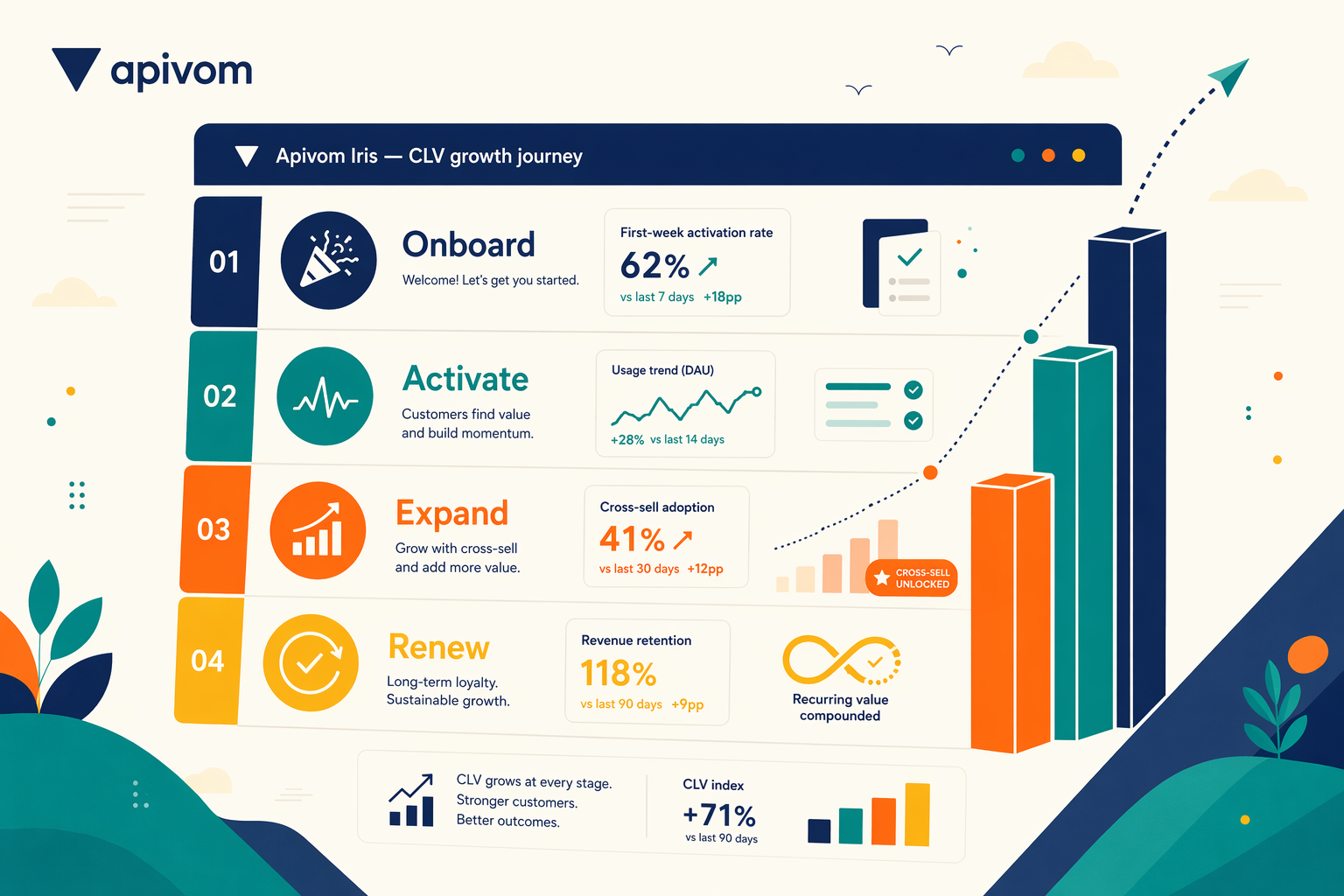
CLV represents the total revenue a business can expect from a single customer account throughout their entire relationship. It goes beyond the initial sale to encompass renewals, upsells, cross-sells, and referrals.
Why CLV Matters
1. Acquisition Cost Perspective
It costs 5-25x more to acquire a new customer than to retain an existing one. By focusing on CLV, you shift resources from expensive acquisition to profitable retention.
2. Revenue Predictability
High CLV indicates stable, predictable revenue streams. This predictability is crucial for planning, investment, and growth.
3. Customer Success Investment
When you understand CLV, you can make informed decisions about how much to invest in customer success initiatives.
How to Calculate CLV
The basic CLV formula is:
CLV = Average Revenue per User x Customer Lifetime
For SaaS businesses, a more accurate formula considers:
- Monthly Recurring Revenue (MRR)
- Gross Margin
- Churn Rate
- Expansion Revenue
Maximizing CLV with Apivom
The Apivom platform is specifically designed to maximize CLV through:
- Early Warning Systems: Identify at-risk customers before they churn
- Health Scoring: Real-time visibility into customer engagement
- Expansion Triggers: Automated identification of upsell opportunities
- Success Playbooks: Proven workflows for customer milestones
Key Takeaways
- CLV should guide your customer success strategy
- Focus on retention before acquisition
- Invest in tools that provide customer health visibility
- Measure and optimize continuously
Ready to maximize your CLV? Discover how Apivom can transform your customer success approach.